Advertisement


 २०८२ चैत्र २५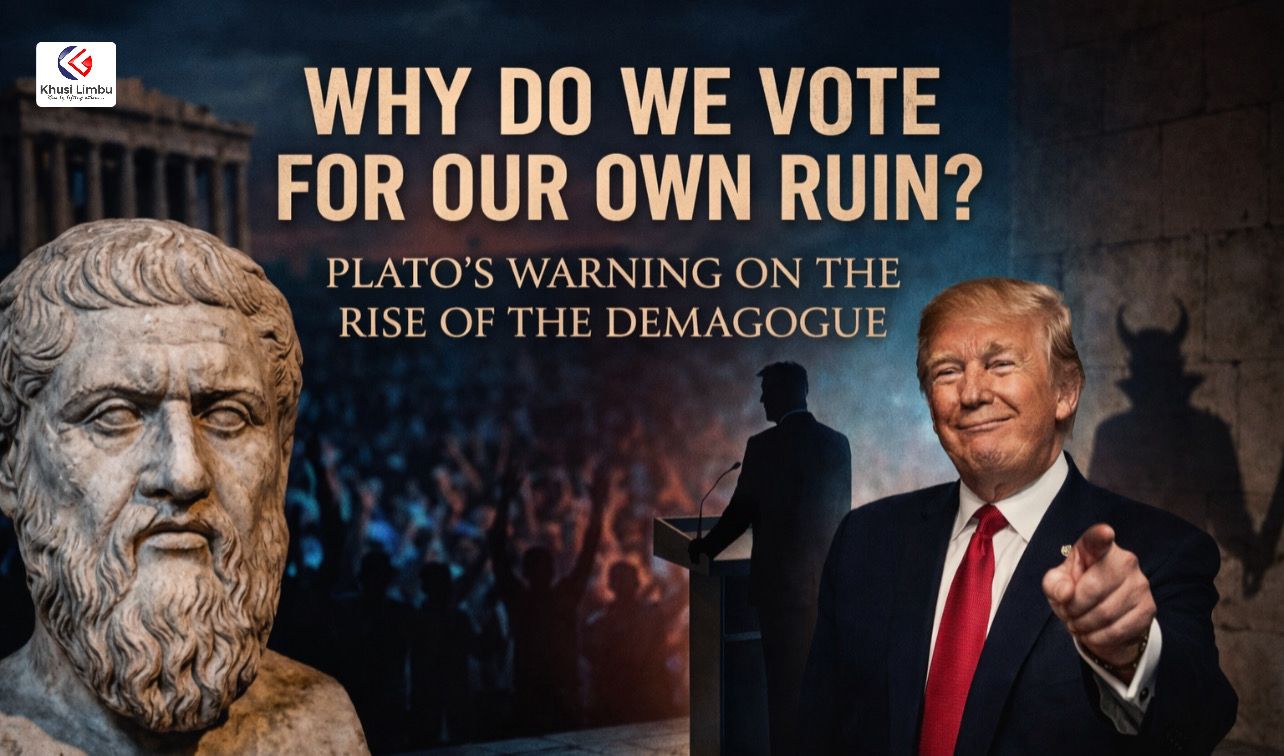
“Who are you supporting this time” — just before the 2024 US presidential election, I asked a Nepalese friend of mine in Texas.
He argued that, under current circumstances, there was no alternative to Donald Trump. His view was partly influenced by the Republican wave in Texas, but more so by a startling kind of ‘blind devotion.’
I had similar debates with other Nepali friends in Alabama, Maryland, and New York. Many insisted the Republican Party was the right choice. Though these were informal conversations, they pushed me toward a troubling question: Why do we, as human beings, often hail forces that work against our own interests as our ‘messiahs’?
I encountered a similar paradox while returning from Gatwick Airport. My taxi driver, a man of African descent in his 50s, turned out to be a staunch Trump supporter. During the journey from the M23 to the M25, he didn’t just criticise Kamala Harris; he claimed Trump was a ‘messenger of peace’ who would save the world from the brink of war. Despite being a UK resident and a member of a minority group, the hope he placed in Trump was deeply contradictory.
We all claim to oppose authoritarianism and totalitarianism. Yet, the ugliness of democracy reveals itself through the behaviour of voters—particularly the ‘pendulum’ and ‘swing’ voters. The way voters are swayed by emotions, lured by greed, or trapped in webs of misinformation to elevate the wrong individuals to power challenges the very claim that humans are ‘rational beings.’
Foreseeing this danger 2,400 years ago, Plato outlined the limits of democracy, labeling it ‘Mob Rule.’ In The Republic (Book VIII), he warned that in a democracy, it is not the rational leader who prevails, but the ‘Demagogue’—the one who excels at inciting the masses.
When we construct our opinions based on immediate personal gain, we lose sight of the long-term landscape. In American politics, the Democratic Party is historically seen as the ally of the working class, minorities, women, and immigrants. On the other hand, the Republican Party is predominantly the camp of the elite, the wealthy, the ultra-conservative, and those with racial biases.
The irony is staggering. For Nepalis and Black individuals—whose interests are rarely a priority in the Republican agenda—to show blind devotion to such a cause is to fall victim to what Karl Marx termed ‘False Consciousness.’ This is a mental state where the oppressed class begins to adopt the ideology of the ruling class as their own. It is not just a failure to recognise one’s own side; it is merging into another’s identity to the point of self-destruction.
During the 2016 Brexit referendum, many immigrants, including Nepalis, supported the ‘Leave EU’ campaign, often harbouring the secret sentiment: “We have already made it into the UK; let’s make sure no more Europeans enter.” Today, the economic decay and political instability facing Britain are right before our eyes.
The tragedy of this system is that the 49.8% of Americans who chose Trump force the remaining 48.3% who voted for Kamala Harris to suffer the consequences of that decision. The delusion or whim of 51% can plunge the future of the other 49% into darkness. Is this the ultimate ‘beauty’ of democracy?
Global politics has reached a critical crossroads. No matter how educated or modern voters claim to be, their decision-making process appears increasingly emotional and narrow-minded. Political philosophers must now ask: Is the current form of democracy the final alternative? Or must we move beyond the whims of the crowd toward a more rational and just system?
As long as we fail to recognise our own class, our own camp, and our own interests, we will continue to cast our votes for our own ‘butchers.’
Ultimately, there is no use in vilifying Donald Trump now. He was placed in that position by an American public that knew exactly who he was and how he operated. One might call the 2016 election a ‘mistake,’ but when the public repeatedly validates such a tendency, they must bear the moral weight and the consequences.
Trump is merely a symbol of the average sentiment and decision of the American people. Whether it is a potential war with Iran or any other geopolitical crisis, the American public must be the stakeholder in every outcome—good or bad—that arises. Until people suffer the ‘penalty’ of their vote, they will never learn.
This is not just about America; it is a harsh mirror for voters worldwide. Before we complain about the rulers we have, we must ask ourselves: “Are we murdering our own conscience just to place a garland around the neck of the butcher?”


 नेपालमामिला संवाददाता